

Why is WordPress getting attacked so often?
WordPress powers a huge share of the web, which makes it the biggest target on it. The core software is maintained carefully. The trouble is everything bolted on top. A typical business site runs a theme plus 20 or more plugins, each written by a different developer, each with its own code that runs on your server every time someone visits.
The numbers back that up. Patchstack's State of WordPress Security report counted 11,334 new vulnerabilities across the WordPress ecosystem in 2025, a 42% jump over 2024, and 91% of them were in plugins rather than WordPress core.
This year has kept the pace. A critical flaw in the Kirki plugin (CVE-2026-8206), active on more than 500,000 sites, let attackers hijack administrator accounts. A 9.0-severity file upload flaw in Elementor Pro's form module (CVE-2026-32475) was reported as actively exploited to drop web shells onto servers in September. Different plugins, same pattern: one missed update is an open door.
How is AI changing website security?
It shortens the attacker's workload. Finding a flaw in someone else's code used to take skilled people days or weeks of reading. In 2026, AI labs and security vendors have reported models that can scan large codebases and surface thousands of previously unknown, high-severity vulnerabilities. Anthropic's Project Glasswing, launched in April 2026, is one widely discussed example, and Wiz's analysis lays out what it means for defenders.
Those same capabilities are not limited to the good guys. The practical effect for a small business owner is simple: the window between "a flaw exists" and "someone is exploiting it" keeps getting shorter, while your plugin update schedule stays the same. Defending a large, constantly changing pile of third-party code gets harder every month. Shrinking the pile is the better strategy.
What is a static website, and why is it harder to hack?
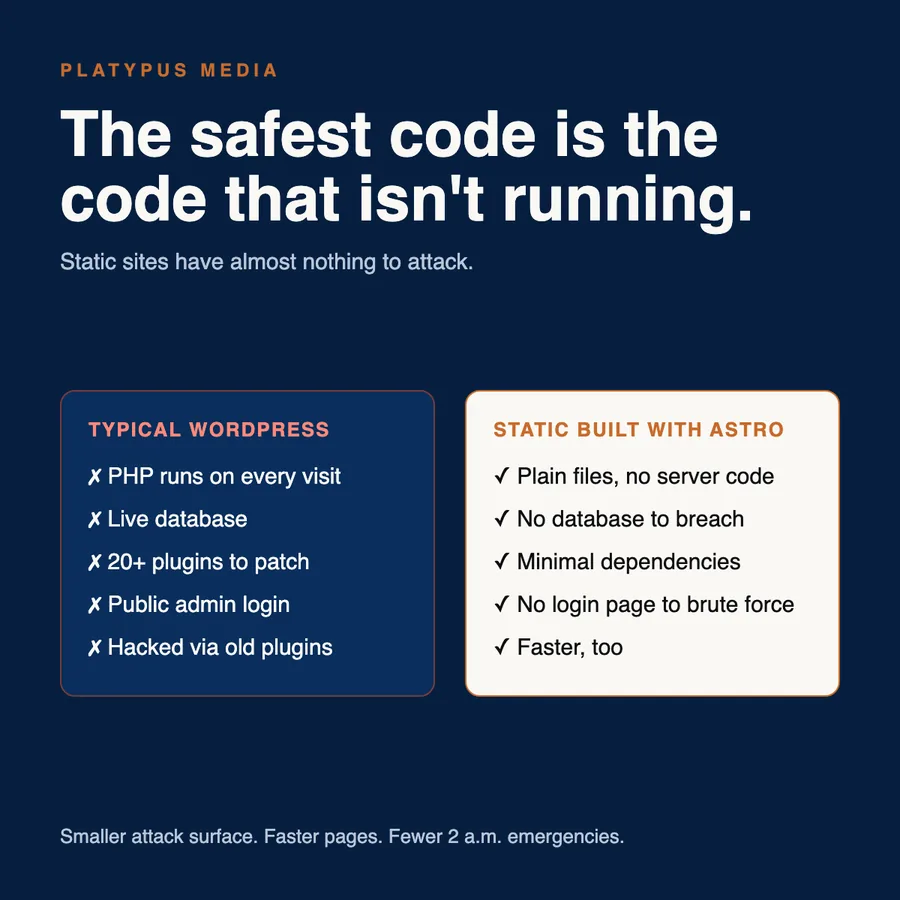
A static website is built ahead of time into plain HTML, CSS and image files, then served from a content delivery network. Astro is the framework we use to build them. When a visitor arrives, nothing is being executed on a server and no database is being queried. There is very little to inject code into, because nothing is running.
| Risk area | Typical WordPress | Static (Astro) |
|---|---|---|
| Server code on every visit | PHP runs every request | None, files are pre-built |
| Database | Live database to breach | No public database |
| Third-party code | 20+ plugins to patch | Minimal dependencies, checked at build time |
| Admin login | Public /wp-admin page | No public login on the live site |
| Typical emergency | Plugin exploit, defaced or malware-infected site | Rebuild from clean source code |
If something ever does go wrong, recovery is also simpler. The site lives in a version-controlled repository, so a clean copy can be redeployed in minutes instead of hunting for infected files.
Can a static site still be hacked?
Yes, and anyone who says otherwise is selling something. Static sites still depend on build tools and packages, the hosting and domain accounts need strong passwords and two-factor login, and a contact form is still a form. The difference is scale. You are protecting a handful of accounts and a short list of dependencies, not an open-ended stack of live server code. We lock down hosting access, keep forms behind spam protection, and keep the editor login invite-only.
Is a static site faster, and does that help SEO?
Almost always. Pre-built pages served from a CDN skip the database and PHP work that slows down dynamic sites, which helps the Core Web Vitals scores Google measures. Speed also lifts conversions, because fewer visitors give up while a page loads. We cover that in detail in our guide to website speed and Core Web Vitals.
Can I still edit my own website without WordPress?
You can. We wire a simple, browser-based editor into every static site so you can change text, swap photos and publish blog posts without touching code. Here is how that editing workflow works.
When does WordPress still make sense?
Static is not right for everything. A large store with live inventory, a membership site, or a team that publishes dozens of posts a day may genuinely need a dynamic platform. But a typical local service business has a few dozen pages, a blog and a contact form. For that, running a full dynamic stack is risk you pay for and never use. If you are on WordPress today and cannot remember the last time it was updated, that is the question to answer this week. Our web development team will tell you honestly whether a move is worth it, and we protect your existing rankings during a migration as part of our SEO work.
Frequently asked questions
Is WordPress secure?+
WordPress core is well maintained, but most breaches come through third-party plugins and themes. Patchstack reported that 91% of new WordPress vulnerabilities in 2025 were in plugins. A WordPress site is only as secure as its least-updated plugin.
Is a static website more secure than WordPress?+
Generally yes. A static site serves pre-built files with no PHP, no live database and no public admin login, so there is much less for an attacker to exploit. It still needs strong hosting account security and careful dependency management.
What is Astro?+
Astro is an open-source web framework that builds fast, mostly static websites. It generates plain HTML ahead of time and only ships JavaScript where a page truly needs it.
Can I move my WordPress site to Astro without losing SEO?+
Yes, if the migration keeps URLs, redirects, titles, meta descriptions and content intact and is monitored after launch. Done carefully, rankings hold and page speed usually improves.